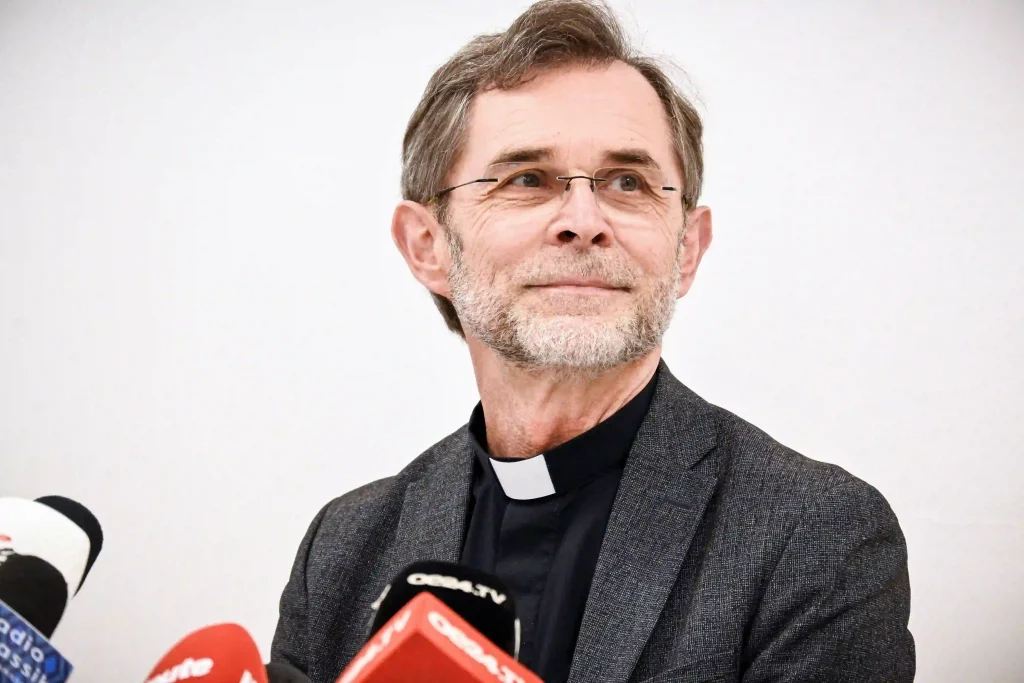
Pope Leo XIV has officially appointed Fr. Josef Grünwidl as the new Archbishop of Vienna, marking a significant transition following Cardinal Christoph Schönborn’s long tenure since 1995. Grünwidl, 63, who has served as the apostolic administrator of the Archdiocese since January 2025, will succeed the now 80-year-old cardinal, whose resignation was accepted earlier this year after a prolonged period of extension beyond the customary retirement age.
The appointment concludes a period of anticipation and careful discernment for the Archdiocese of Vienna. Cardinal Schönborn had submitted his resignation in 2020 upon reaching the age of 75, in accordance with canon law. However, the late Pope Francis requested that he remain in office until a suitable successor was identified. This delay was met with understanding within the archdiocese, recognizing the importance of a seamless leadership transition.
At a press conference held shortly after the Vatican’s announcement, Archbishop-designate Grünwidl candidly shared his initial hesitation about accepting the role. Upon assuming the responsibilities of apostolic administrator earlier this year, he found the scope of duties overwhelming and even expressed doubts about his capacity to lead the archdiocese. Yet, persistent encouragement from church leaders and the faithful convinced him to embrace the position. He emphasized his willingness to serve with humility, stating, “God doesn’t want me to be perfect, but available.”
Grünwidl’s vision for his new ministry centers on being a pastor, a collaborator, and a bridge builder. This approach aligns with the pastoral style of his predecessor, Cardinal Schönborn, who expressed confidence in Grünwidl’s leadership and assured the faithful that the archdiocese was in capable hands. Schönborn’s endorsement underscored a continuity of care and pastoral sensitivity for Vienna’s Catholic community.
Born in 1963 in Hollabrunn, Austria, Grünwidl was ordained a priest in 1988 for the Archdiocese of Vienna. His early ministry included various pastoral assignments and a notable role as personal secretary to then-Archbishop Schönborn from 1995 to 1998. Beyond his theological education, Grünwidl also trained as an organist, reflecting a well-rounded formation in both spiritual and cultural dimensions.
While known for his pastoral dedication, Grünwidl’s background includes a period of association with the “Priests’ Initiative,” a reform-minded group founded in Austria in 2006. This group gained attention for advocating progressive changes such as the ordination of married men and women, Communion for divorced and remarried Catholics, and greater lay participation in liturgical roles. Grünwidl eventually distanced himself from the group, acknowledging that many of its concerns had been addressed by Pope Francis and expressing reservations about the group’s use of “disobedience” as a strategy.
Nevertheless, Grünwidl remains an advocate for reform within the Church. In a recent interview, he highlighted the indispensable role of women in parish life and called for their increased involvement in decision-making bodies. He acknowledged that the question of women’s ordination remains a pressing issue, especially among younger Catholics, who often struggle to understand the exclusion of women from the priesthood. Furthermore, he suggested that the female diaconate deserves renewed discussion, signaling openness to exploring expanded ministerial roles for women.
On the topic of priestly celibacy, Grünwidl expressed that it is not a matter of faith doctrine but a discipline that could be reconsidered. This perspective aligns with ongoing conversations within the global Church about adapting traditions to contemporary pastoral needs.
Grünwidl’s spirituality emphasizes lived faith expressed through daily actions rather than solely through formal religious observances. He stated that true spirituality is reflected in one’s behavior toward others in everyday life, underscoring a practical, relational faith.
His appointment comes at a time when the Catholic Church faces numerous challenges, including declining Mass attendance in Europe, secularization, and the need to engage younger generations more effectively. Grünwidl’s pastoral sensitivity and openness to dialogue position him well to address these issues in Vienna, a city with a rich Catholic heritage but also a highly secularized society. His emphasis on teamwork and bridge-building suggests a leadership style that values collaboration among clergy, religious, and laity alike.
The new archbishop’s willingness to engage with contemporary questions—such as the role of women and celibacy—signals a potential for measured reform that respects tradition while responding to the evolving needs of the faithful. As he steps into his new role, Grünwidl faces the task of guiding the Archdiocese of Vienna through a complex cultural and spiritual landscape, fostering a Church that is both rooted in its heritage and open to renewal.
The faithful of Vienna and the broader Church watch with hopeful anticipation as Grünwidl prepares to take on this significant responsibility. His leadership promises to balance continuity with innovation, offering a vision of the Church as a welcoming, inclusive, and dynamic community ready to meet the challenges of the 21st century.