Vivek Ramaswamy, a prominent Indian American entrepreneur and political figure, recently found himself at the center of a complex conversation about Hinduism during a Turning Point USA event at Montana State University. His attempt to articulate his faith to a largely Christian audience sparked both praise and criticism, highlighting a longstanding challenge faced by Hindu Americans: how to explain a deeply diverse and often misunderstood religion in a way that resonates with Western audiences.
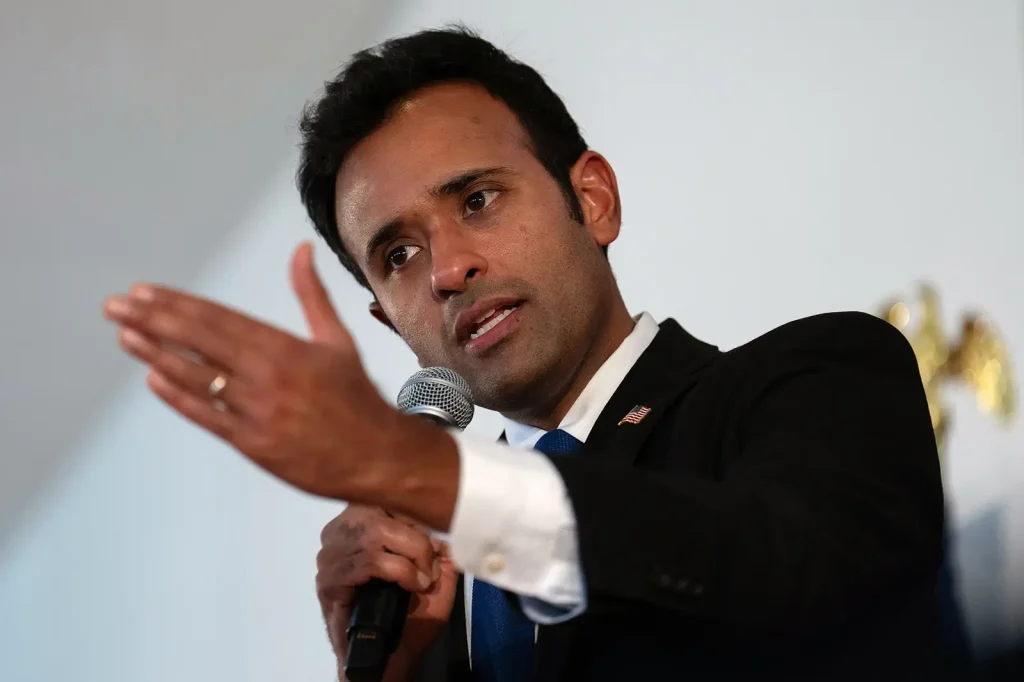
At the event, an MSU student questioned Ramaswamy’s presence at a Christian-oriented forum, citing Hinduism’s reputation as a “polytheistic” faith. Ramaswamy responded by identifying himself as a monotheist, drawing a parallel between Hinduism and Christianity’s Holy Trinity. He explained that his belief centers on one true God who manifests in many forms, a concept rooted in the Advaita Vedanta philosophy. This school of thought posits that Brahman, the singular supreme reality, expresses itself through countless deities and forms, making Hinduism a religion that embraces both unity and multiplicity.
Ramaswamy’s explanation was praised by many Hindu Americans for its succinctness and clarity, especially given the constraints of a public political forum. However, some criticized his approach as an oversimplification or as an attempt to fit Hinduism into a Western, Christian framework. His comparison of the Hindu pantheon to the Christian Trinity sparked controversy among some Christians as well, who viewed the analogy as disrespectful.
This incident underscores a broader issue: Hinduism’s complexity and theological diversity make it difficult to convey in simple terms, especially within a Western context that often expects religions to fit neatly into monotheistic or polytheistic categories. Hinduism, unlike many Western religions, lacks a singular dogma or creed. It encompasses a wide spectrum of beliefs, including monotheism, polytheism, pantheism, and even nontheism, often coexisting within the same tradition.
The difficulty in defining Hinduism is not new. The term itself was coined by British colonizers in the 18th century, who imposed a Protestant Christian lens on the varied spiritual practices of people living around the Indus River. This colonial legacy continues to influence how Hinduism is perceived and explained today, particularly among second-generation Indian Americans who navigate the tension between their ancestral faith and Western cultural norms.
Experts note that many American-born Hindus tend to frame their beliefs in ways that align with Abrahamic religions, partly to make them more understandable to a predominantly Christian society. This tendency can be seen as a form of cultural adaptation, but it also risks diluting the richness and nuance of Hindu thought. The historical precedent for this goes back to 19th-century reformers like Raja Ram Mohan Roy, who sought to present Hinduism in a rationalist, monotheistic light to engage Western audiences and counter colonial critiques.
Ramaswamy’s use of Christian terminology reflects this ongoing pressure to translate Hindu concepts into familiar terms. As a public figure within the Republican Party in Ohio, he likely feels the need to bridge cultural and religious divides to connect with a broader electorate. Yet, this balancing act is fraught with challenges, as it can alienate both traditional Hindus who value theological precision and Christians who may view such comparisons as inappropriate.
The generational gap also plays a significant role. Many young Hindu Americans attend temple less frequently and instead practice specific family rituals, leading to a more individualized and sometimes fragmented understanding of Hinduism. This disconnect from both their parents’ traditions and mainstream American religious culture complicates efforts to articulate a cohesive Hindu identity.
Despite these challenges, there is a growing movement among Hindu Americans to reclaim and define their spiritual heritage on their own terms. This process involves embracing Hinduism’s pluralism and resisting simplistic labels. It also requires patience, as broader American society gradually becomes more receptive to religious diversity and complexity.
Looking ahead, scholars and community leaders are hopeful that increased awareness and education will help demystify Hinduism over time. While it may take decades for the full depth of Hindu philosophy to be appreciated in the West, the dialogue sparked by moments like Ramaswamy’s TPUSA encounter is a vital step forward. It encourages both Hindus and non-Hindus to engage with the religion’s rich tapestry of beliefs and to move beyond reductive stereotypes.
In conclusion, Vivek Ramaswamy’s experience illustrates the intricate challenge of explaining Hinduism in a predominantly Christian cultural environment. His attempt to frame Hinduism through the lens of monotheism and the Trinity metaphor reveals both the necessity and the difficulty of making Hindu beliefs accessible to a wider audience. As Hindu Americans continue to negotiate their identity in the United States, their efforts to educate and build understanding will be crucial in fostering respect for one of the world’s oldest and most diverse religious traditions.